Market News
Dubai Approves AED 34 Billion Metro Gold Line
The emirate's largest transport project connecting 15 key areas and over 55 served developments, set to open on 9 September 2032.
23 April 2026 · Metropolitan Premium Properties
On 22 April 2026, Sheikh Mohammed bin Rashid Al Maktoum approved the Dubai Metro Gold Line, the largest transport project in the emirate's history. The AED 34 billion line will run 42 km entirely underground, adding 18 stations and expanding the network by 35% (from 120 km to 162 km).
The project addresses growing demand on the Red Line, especially between BurJuman and ONPASSIVE, where congestion is expected to drop by 23% once it opens. Citywide, it is projected to remove more than 40 million road journeys per year.
Total Investment
AED 34B
$9.26 billion
Route Length
42 km
18 stations · 15 areas
Opening Date
9 Sep 2032
Fully underground
Daily Riders by 2040
465,000
1.5M residents served
The Route · 13 Stations
From Old Dubai to Jumeirah Golf Estates
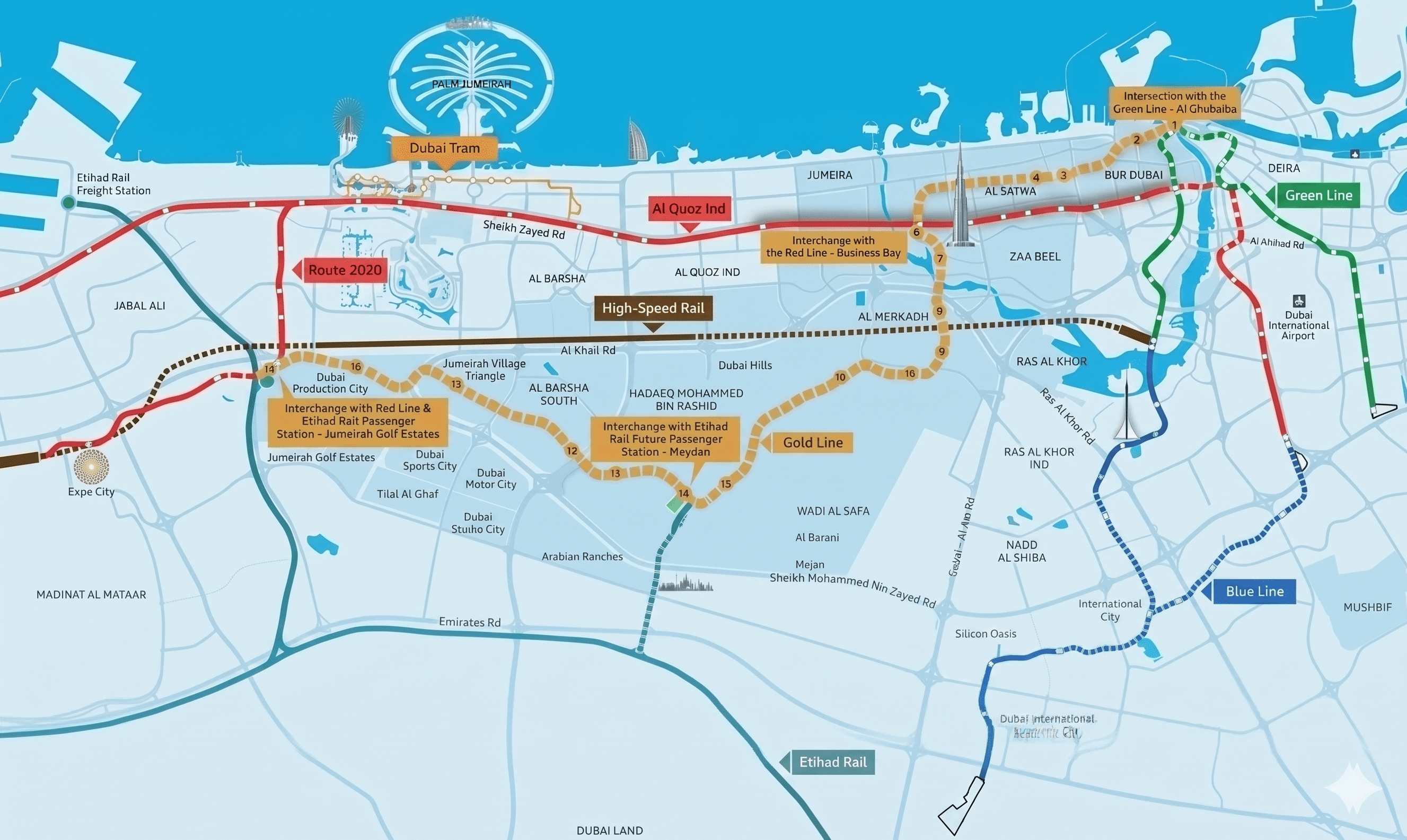
The Gold Line starts at Al Ghubaiba in Bur Dubai and runs southwest through some of the city's busiest residential and investment areas, ending at Jumeirah Golf Estates.
It connects with the wider network at four points: the Green Line at Al Ghubaiba, the Red Line at Business Bay and Jumeirah Golf Estates, and Etihad Rail at Meydan and Jumeirah Golf Estates, linking the metro to the national rail network.
Al Ghubaiba
Green Line ↔
The historic heart of Bur Dubai, home to the Gold Souk waterfront and the traditional dhow wharfage. Starting point of the Gold Line and interchange with the existing Green Line.
A large-scale waterfront master plan by DP World, featuring residential towers, a yacht marina, and over 3 km of canal-facing promenade. Notable projects include Emaar's Marina Vista and Palace Residences.
Meraas's open-air mixed-use district in Jumeirah, combining retail, dining, hotels, and branded residential towers. Known for La Ville Hotel and the Bulgari Resort nearby.
BurJuman
Red + Green ↔
One of Dubai's busiest transit junctions, connecting the Red and Green Lines. The Gold Line adds a third interchange, making BurJuman the most connected station on the network.
Dubai's primary CBD extension, running along the Dubai Water Canal. Home to offices, hotels, and high-density residential towers. Already Red Line-connected; the Gold Line adds a second interchange, making it the most transit-accessible business district in the city.
One of Dubai's largest master-planned developments, spanning over 54 million sq ft. Includes District One, Sobha Hartland, the Meydan One Mall project, and dozens of active off-plan launches.
A fast-growing villa community adjacent to the Meydan Racecourse. Popular with families for its spacious plots and relatively affordable entry point compared to older villa districts.
MBR Gardens
Sheikh Mohammed Bin Rashid Gardens — a large-scale green urban district planned for the southern MBR City corridor, including parks, cultural spaces, and residential zones.
Built around the Meydan Racecourse and the world-famous Dubai World Cup venue. A dual interchange with Etihad Rail makes this one of the most strategically connected stations on the entire Gold Line.
Global Village
Dubai's largest multicultural family entertainment destination, running seasonally from October to April. Direct metro access for the first time will significantly improve connectivity for the millions of visitors it draws each season.
A mid-market residential district home to Motor City, Dubai Science Park, and several established villa and apartment communities. Previously underserved by metro infrastructure.
One of Dubai's most active investment communities, with thousands of apartments across a wide price range and consistently strong rental yields. Metro access has been a long-standing gap — the Gold Line closes it.
The southern terminus of the Gold Line. A premium golf community home to the DP World Tour Championship course. The Etihad Rail interchange here positions it as a gateway between Dubai's metro network and the national rail system.
Real Estate
Impact on Property Prices and Demand
The RTA confirmed the Gold Line will serve more than 55 major developments currently under construction along its route. Areas close to metro stations have consistently seen higher demand and price growth across Dubai.
After the Blue Line announcement, Dubai Silicon Oasis saw prices per square foot rise by 29% as buyers moved in early. Metro projects are often reflected in prices years before completion, giving buyers a window to enter before the Gold Line opens in 2032.
The biggest impact is expected in areas getting metro access for the first time, including Meydan, MBR City, Nad Al Sheba, JVC, and Jumeirah Golf Estates. Business Bay, already on the Red Line, will gain a second connection, further strengthening its position as one of the city's best-connected areas.
Construction Timeline
From Tender to Inauguration
2026
Tenders are issued. The Gold Line is part of the Rail Network Plan 2032, alongside the Purple and Pink Lines, which are still in early stages.
2027
Contracts are awarded and construction begins. The line will be built underground using tunnel boring machines at depths of up to 40 metres, reducing disruption at street level.
9 September 2032
Opening day. The Gold Line is set to be delivered 30% faster than the Blue Line. Once complete, the Dubai Metro network will reach 162 km and 85 stations.